Last Updated: May 2026
Cash-Secured Puts: What They Are and How to Use Them
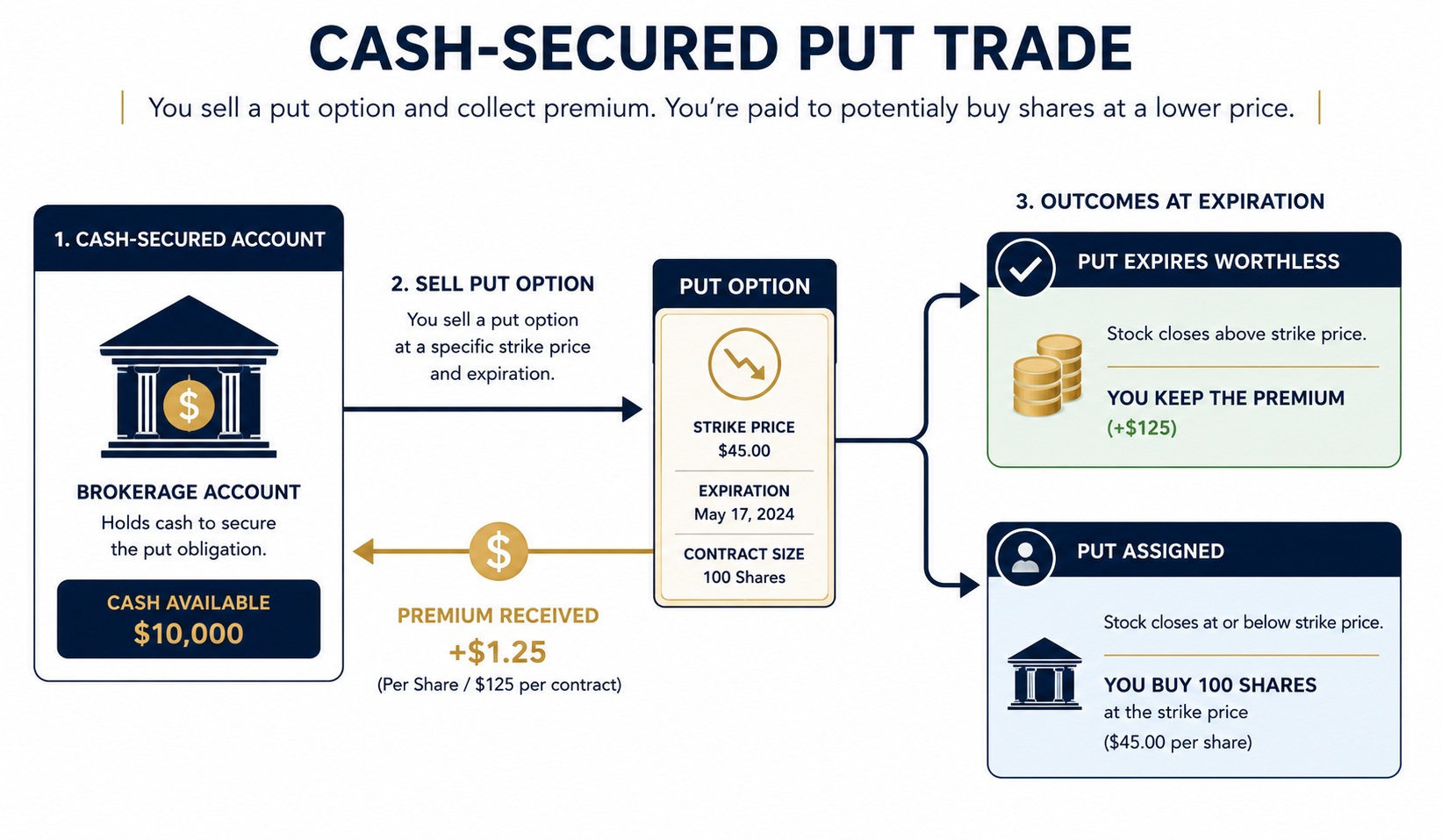
Cash-secured puts are the starting point of the Wheel strategy. They let you collect premium while agreeing to buy a stock at a price you choose, provided you keep enough cash available for assignment.
What Is a Put Option?
A put option gives the buyer the right to sell 100 shares at a specific strike price before expiration. When you sell that put, you take the other side: you may be required to buy those shares at the strike price.
The buyer pays a premium for the right. The seller receives that premium immediately, but the obligation remains until the option is closed, expires, or is assigned.
What Makes It Cash-Secured?
Cash-secured means you hold enough cash to buy the shares if assignment occurs. If you sell a $45 put, you reserve $4,500 per contract, minus any premium mechanics your broker displays. This keeps the trade grounded and avoids accidental leverage.
That cash requirement can feel inefficient when the option expires worthless, but it is also what makes the strategy simpler and more survivable for many retail traders.
Why Sell Cash-Secured Puts?
A cash-secured put can be viewed as a limit order that pays you. If you wanted to own a stock at $45, selling a $45 put creates income while you wait. If assigned, your premium reduces the effective entry price.
The danger is using that logic on stocks you do not actually want. Premium is tempting, especially in volatile names, but a high premium often exists because the market sees real risk.
How to Choose the Right Strike Price
Many Wheel traders start around 0.25 to 0.30 delta because that range is often far enough out of the money to offer a cushion while still paying meaningful premium. Delta is not a promise; it is a market-derived estimate that changes as price and volatility move.
Choose the strike by combining delta with your own valuation. If assignment at that strike would make you uncomfortable, the trade is too aggressive no matter how attractive the premium looks.
How to Choose Expiration
The 21 to 45 days to expiration window is popular because theta decay becomes more noticeable while premium remains substantial. Shorter expirations may feel safer but require more decisions and can be jumpy around news. Longer expirations collect more premium but tie up cash for more time.
A consistent expiration range also makes your results easier to evaluate. You can compare trades honestly instead of changing every variable at once.
Managing the Trade
Many traders close a winning put early once most of the premium has been captured, then redeploy capital. Others let it expire if transaction costs and assignment risk are acceptable. Rolling can make sense when you can collect additional credit and still like the underlying.
Taking assignment is not failure in the Wheel. It is one of the planned outcomes. The real failure is selling a put without enough cash, without a stock thesis, or without knowing the next step.
Example Trade Walkthrough
Suppose a quality stock trades at $52 and you sell a 45-day $48 put for $1.00. You collect $100 and reserve $4,800. If the stock remains above $48, the put may expire worthless and the $100 is yours. If assigned, your effective basis is roughly $47 before costs.
From there, you can sell covered calls, ideally above your adjusted cost basis. That is how the put phase leads naturally into the call phase of the Wheel.
Risks to Understand
The main risk is a large stock decline. If the company falls from $52 to $30, your $100 premium helps only a little. Cash-secured does not mean loss-proof; it means you can meet the obligation without borrowing.
You also face opportunity cost, early assignment, tax considerations, and liquidity risk. Respect those risks and the strategy becomes a process instead of a premium chase.
Want the Complete Playbook?
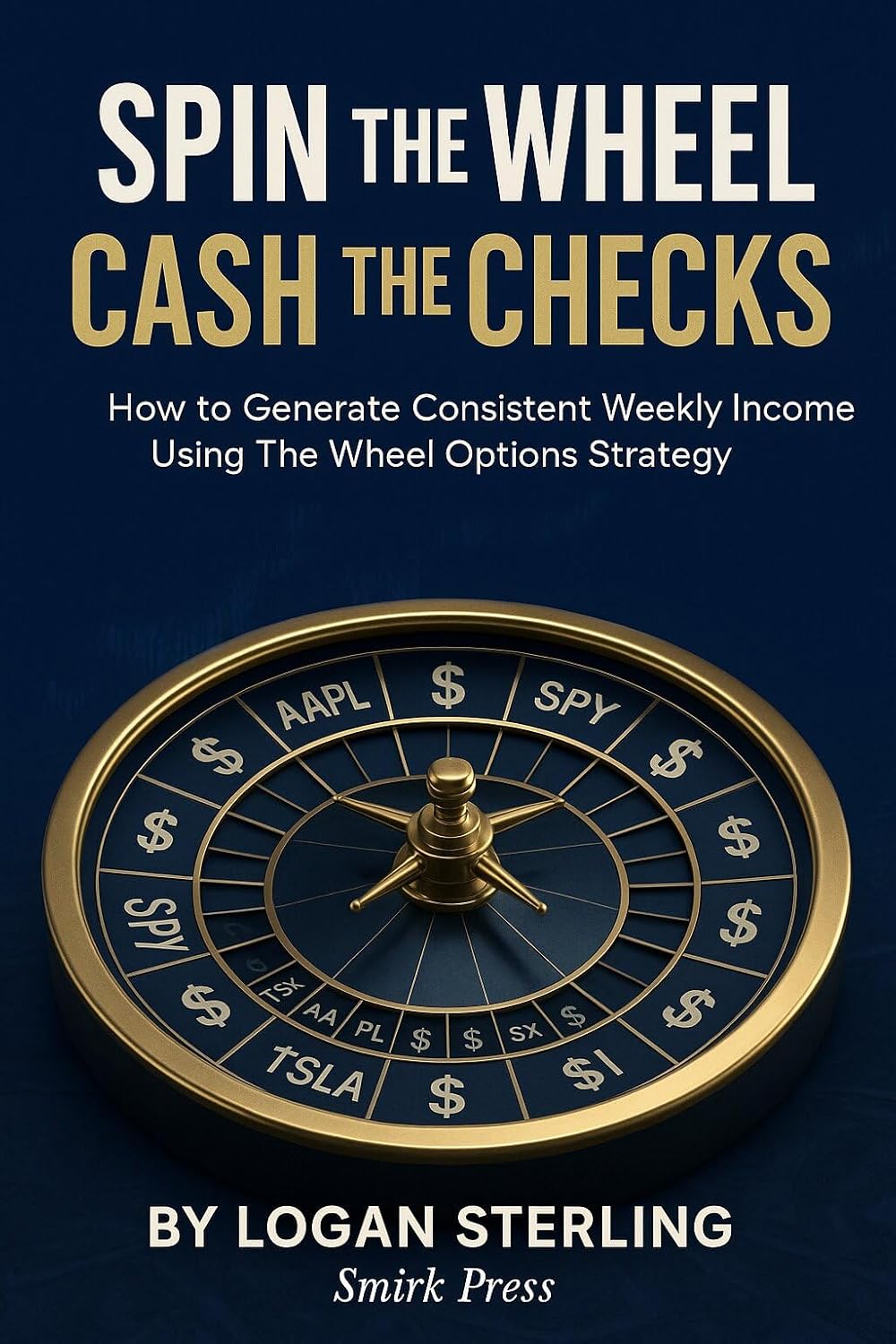
Spin the Wheel, Cash the Checks by Logan Sterling walks you through every step of the Wheel strategy - from stock selection to trade management - with real examples and a repeatable system you can start using immediately.
View on Amazon